
Table-Talk: Question # 12
What would you want to tell.....

I am very happy that my little experiment with Q # 11 paid off. I am flattered that so many people on and outside of this virtual table, recognised in these few selected characters, real people they meet or would rather not meet in their daily lives. Moreover, they came up with their own suggestions for expanding the list. In summary, however, I would say that we agree to disagree on the following:
a) on an individual level, people are not usually scary per se; they may simply appear frightening for many different reasons (Brenna Lee)
b) best to avoid dumb, smug people who do not know what they do not know ( Peter Maguire)
c) Jane Austen does the best baddies (Plain Jane)
=====================================================================
Reading this next question, it feels as if I am about to sit with my daughter, cosy by the fire, and tell her a fairy tale full of twists, mysteries, and, ultimately, a happy ending about a dark forest called the world of work. Because the world of work can be unpredictable and scary as a dark forest. She will listen with an open mouth and will be absorbing her mother’s proverbial wisdom, which will, in turn, make her life in this world of work as easy and carefree as a walk in the park. So let’s see how this fairy tale goes.
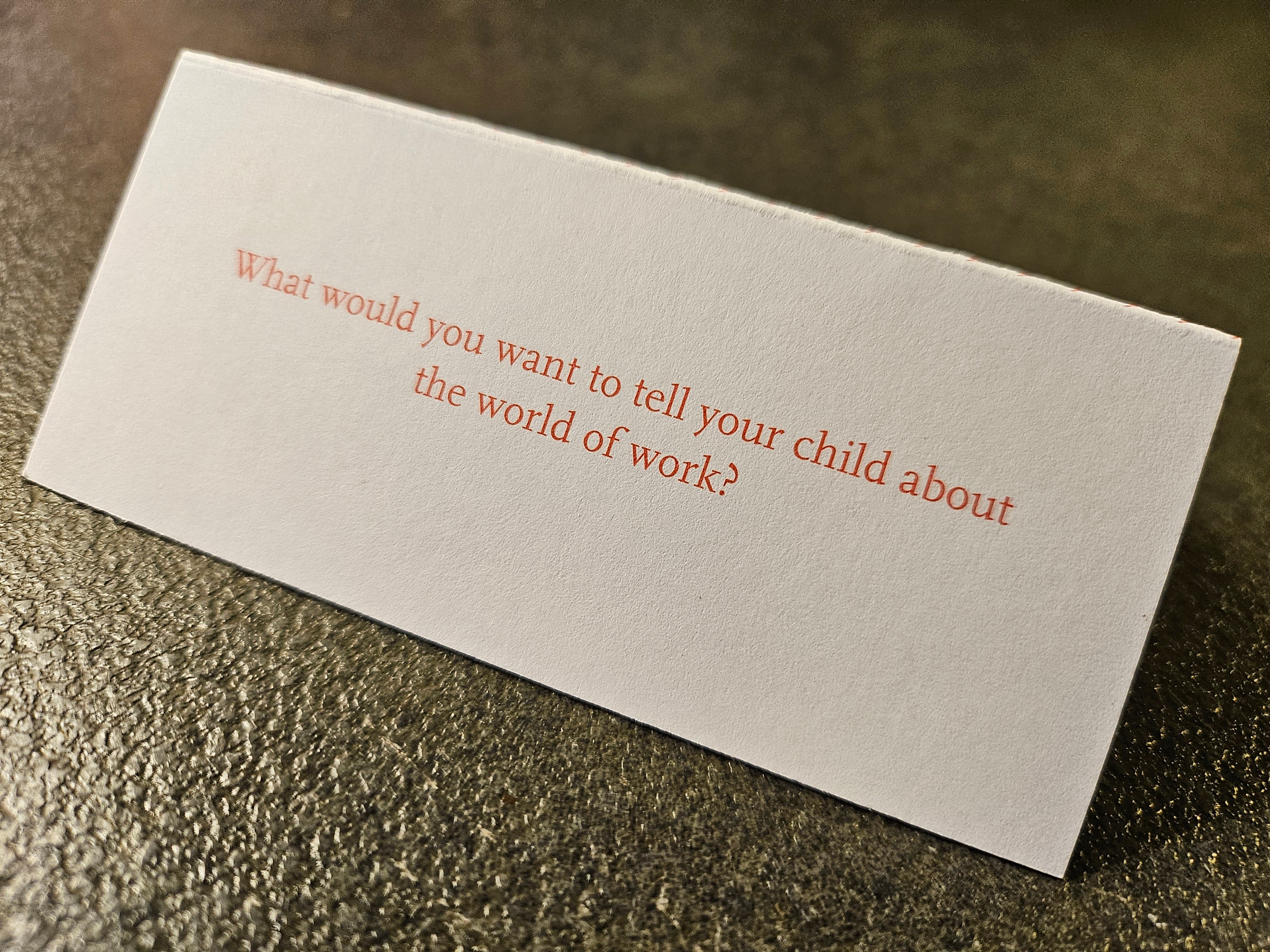
When I was growing up, there were a number of unwritten, largely unspoken, and somewhat cynical rules related to the world of work.
The first and most important one was: “study so you don’t have to work”. In communist Bulgaria, work was associated mainly with manual labour. Although communism was, in theory, all about celebrating the Worker, in practice no one would encourage their child to become one.
Ideally, your child should become a doctor, an engineer, or an architect: instantly recognised profession by the few letters in front of their name (e.g. Dr Ivanov; Eng. Ivanov; Arch. Ivanov). Failing that, they could pursue something as trivial as teaching or accounting. Failing even that... well, a cleric of some sort in an office of some sort would do. I remember the illiterate old neighbour of my grand parents was praising herself that non of her three children works “outside”, meaning they all had office jobs.
Connections matter. We didn’t know then what unemployment was; everyone had a job. Once you had finished your studies, you were assigned, through central planning, to a workplace in some remote corner of the country, and unless your parents had very good “connections,” there was no escape. Family ties and connections were therefore important. If I do you a favour today, you would do me a favour tomorrow. If you happened not to be well connected, you could find yourself working as an accountant in a remote post office 300 kilometres from the place where you were born, as happened to my father.
Practical loyalty (but watch you back). Once you started working, you were expected to be, for lack of a better word, obedient. You were not supposed to be a critical thinker, to stand out too much, or to show off how much you knew. You were supposed to be visible, but only just visible enough. To be liked, but not so much that others would envy you. Most people would spend their entire working lives in the same sector. You might eventually move slowly up the hierarchy, but it was very rare for someone to switch to a completely different field.
For many people, the work ethic could be loosely summed up by this popular at the time saying: “I pretend to work, and you pretend to pay me.” I guess we were among the first to discover the “BS” jobs.1
It is important, however, to say that there were millions of hardworking and honest people who were trying to make it under the system quietly, with dignity and conviction. So…this was more or less the world of work as I knew it in 1989, when I was in my early twenties. Then the seismic political changes began, and all these rules became blurred as the entire structure collapsed like a house of cards. Jobs started disappearing, and family ties and connections became more important than ever. The best we could do was improvise. So, if I were to give my child (or any child) a piece of advice, it would be that “improvisation” and “connections” can take you a long way.
Moving to the Netherlands in 2000, when the economy was booming and capitalism flourishing, I had to adapt to a new set of unwritten, largely unspoken, and somewhat cynical rules related to the world of work. They were very, very different from those I had known before. Before moving to NL, I had never been through a thorough selection process or attended a job interview. I didn’t know that you were expected to be competitive, to show initiative and ambition. I didn’t know that you are not supposed to be a “9 to 5 mentality,” that there will be demand to prioritise work over family and expectation to work long hours. Some might even refuse to hire you because you did not own a car. There was this urge to make you believe that “the company” was your own big, happy family, even though “the company” often paid little more than the minimum wage and could dismiss you in the “interest of the service” whenever it saw fit. There were many rules I had no clue about.
One would say that these two worlds of work are also worlds apart, but on closer look, they both value higher education and connections (or “networks,” as they prefer to call them). Both “the system” and “the company” have become almost invisible human personifications, something with which you believe you are in some sort of “relationship,” almost a romantic one (and no, I don’t mean with the boss :-)). Yet they are clearly not in the same kind of relationship with you. Funny, isn’t it, the perception that you might be valued.
At one point in early 2000s, I was working for a well-known logistics company. I remember that around Easter the branch manager gathered the entire staff, about 250 people to announce the company’s impressive profits and thank us for our hard work. As a gesture of gratitude from the management, he proudly gave each of us a pack of supermarket chocolate Easter eggs. They were not even quality boutique chocolates; they were just plastic packs of 2 euro each. In other words, the company spent roughly 500 euros out of its huge profits to say “thank you” to the people who had made those profits possible. Maybe it was my communist-brainwashed mind, but I felt deeply offended and, in a weird way, ashamed to witness that whole thing. Most of those people standing awkwardly there, in the middle of the hallway, worked on the warehouse floor, moving heavy packages all day. They were on temporary contracts, earning minimum wage, and were rewarded with a pack of cheap chocolates, while the shareholders and the Chief whatever Officers went home with fat bonuses. Welcome to the world of work. When I was reading “Intermezzo” by Sally Rooney, one argument of her gentle character Ivan made me wonder of the value of the work we do:
“I do a little of bit of data analysis [….] they will give me a lot of data […] and I’ll spend a few hours making graphs and whatnot. Say it takes me-I don’t know, four hours to make those graphs, and I’ll pretend it took me ten hours, to get more money […..] You think that is immoral, I don’t know [….] My question is, what is the money that’s being paid to me? It’s the money that the company will pay, to have their own information explained back to them in a graph. And how much money should that be? Clearly no one knows, because at the end I’ll make up a number of hours and they will just pay me for that number. I guess the graph is supposed to make the company more profitable, in theory, but no one knows by how much, it is all made up. […..] But you do literary have people going hungry, I know that’s a cliche. Food shortages, it is a real thing. And then you have these tech companies paying me to make a graph. Why? It comes from a wrong distribution of resources.
“Intermezzo”, Sally Rooney (2024)
This is just a flavour of what Ivan had to say. In fact his monologue is about two pages long, and I find it amusing but very powerful. Because in many ways, I think exactly like Ivan. Maybe it is my communist-brainwashed maind: I see a wrong distribution of resources everywhere. That is why I know I am not suited to working in business; my mindset is different. The quotation above also reminds me that there are many meaningless jobs out there, or “BS jobs,” as the anthropologist David Graeber formulates in his book:
“a form of paid employment that is so completely pointless, unnecessary, or pernicious that even the employee cannot justify its existence even though, as part of the conditions of employment, the employee feels obliged to pretend that this is not the case.”
That, too, is a world of work.
As I don’t have mindset for business, I went to work for a public international organisation and became an international bureaucrat. Public organisations are slow, heavy on rules and procedures, full of experts of one kind or another. The work can be occasionally dull, after all the public sector is not immune to BS jobs…. But at least we have the benefit, the belief, or perhaps the illusion that we serve the public good.
But don’t get me wrong, the world of work is very important. Work gives us meaning and satisfaction; it is a place to shine, a place to learn and to grow, to be social, and to challenge ourselves. Work can be a source of joy, of pride and fulfilment. And according to the World happiness Foundation:
Globally, 70% of employees say they are happy at work, including about one in four who identify as “very happy”2
I, for one, have also had a lot of fun at work. Over the years, I have had many wonderful colleagues and found inspiration, motivation, and drive in my working life. But I have also tried to keep a clear demarcation line between my private life and my professional life. Some colleagues became friends, but I never saw them as one big happy family; after all, families are complex enough. And I never, ever tried to be in a “relationship” with the organisation, because the organisation’s priority is not strictly speaking me.
But perhaps everything I can say to my child about the world of work is already obsolete and irrelevant in this climate of economic stagnation and rapid technological change, of shrinking opportunities for (perhaps overqualified) young people, hybrid work, and overall uncertainty and global tension. At the end of this kaleidoscopic tale about the world of work, I can only repeat what I already said in my Q # 3 post:
….at a time when my daughter is bravely kick-starting her career into the unknown and mine is slowly cruising toward sunset, I can only suggest this to anyone who is interested: embrace flexibility, don’t be afraid to improvise, and learn to make something with your hands: it comes handy. Because, progress moves in two directions: as some doors inevitably close, others open. Learn to recognise the ones you can walk through (and occasionally keep a few open for others to follow)
My daughter has chosen a very different professional path from mine. She will have to discover for herself what her world of work looks like, because the world of work is not universal; it is different for every single one of us.
What is your tale for the world of work?

https://davidgraeber.org/books/bullshit-jobs/
https://worldhappiness.foundation/blog/organizations/happiness-at-work-in-2025-insights-from-our-3rd-annual-report-and-global-trends/
I absolutely love this, no notes
I remember "about celebrating the Worker,". We also had those in Romania as well.
Can't say it did us much good on long term analysis.
The good work life that was implemented to me as a child was : school, scholl, scholl so you can have a chance to leave the country as someone who makes money (meaning not a millionaire of course, but enough to pay the bills, even barely surviving in another country, as long as it was decent work) , otherwose, no scholl meant (as a girl) you'll become a P...ti...tute. so those were the options for me at least, while growing up: learn and stay on the streets.
That's the work life :)
https://danieladurbaca.substack.com/p/may-day-as-a-native-and-as-a-foreigner