
Table-Talk: Invitation # 15
If you have to redesign.....

I blame the weather for the low interest in my previous post about ambition..who would think of ambition if it is boiling 36°C outside..But then if I look at the previous 13 posts, they have performed more or less the same, equally badly or equally well (depending if you are glass half empty/ or glass half full kind of person). But being the opportunist that I am, I would say it is the weather…works both ways (too hot: people stay indoors and read essays about ambitions/too hot: people have no energy to read essays about …well, anything, ambition included).
But there is one very important update to share...
One of my aspirations (to be checked in previous post Q14) has turned into reality, and with very little inconvenience for myself too. I didn’t have to do a thing! I was very generously offered around 100 books from Biblioteka Galactica1. So that point has now moved from the realm of dreaming to the realm of enjoying. And I am incredibly happy and very grateful to this person, I will take good care of those books, because they have sentimental value for both me and the donor.
Who says manifestation doesn’t work? I’m now starting to manifest the Aurora Borealis appearing over Stockholm under perfectly clear skies. That would be spectacular.
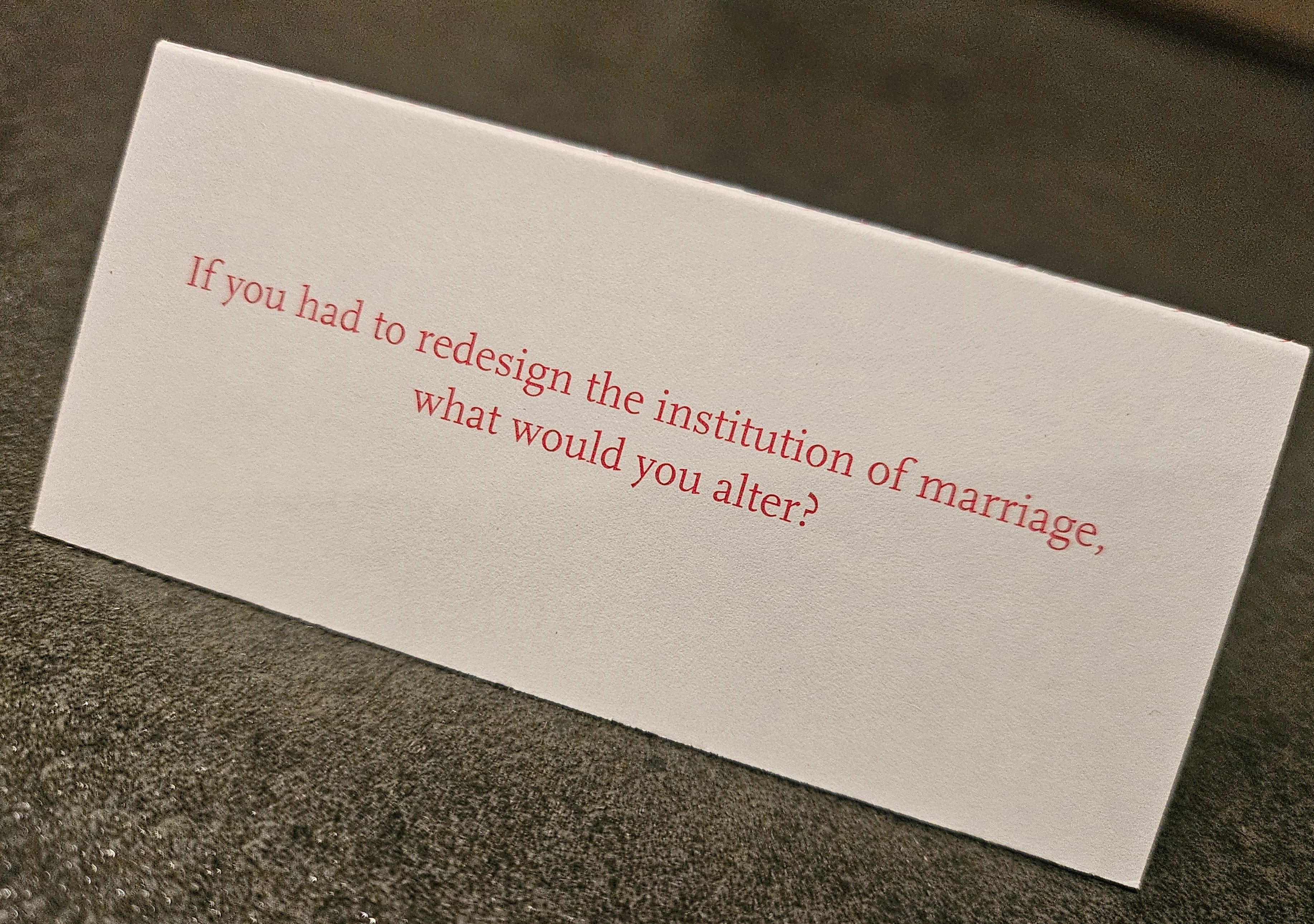
Developing today’s question is a high level exercise…where do you start to redesign even conceptually an institution that is about…4350 years old2? Although, this essay has no ambition to provide a chronology of the institution of marriage or to ponder on who, if anyone is to blame for its imperfections, I will need all the help I can get, and as we say in Bulgarian, “I will bring water from many springs” (meaning using many sources).
And, I will start with the heavy weight:
"All happy families are alike; each unhappy family is unhappy in its own way."
Anna Karenina, Leo Tolstoy (1878)
Probably one of the best known openings lines in literature. The moment you read that sentence, you know:
a) this book is going to be about unhappy marriage…
b) it is going to be soul crushing…
c) better decide whether to continue reading or not…
If I think about all the books that have been written and all the films that have made with unhappy marriage as source of inspiration, I would say that unhappy marriage is, at the very least, worth something3. But if you find yourself trapped in an unhappy marriage, the only thing you can think of is how to get out of it. Luckily the institution of marriage has evolved and people nowadays, even in more socially conservative societies have the option to step out.


But with all its evolution, the institution of marriage has not yet come with a radical transformation or offer alternative solution for parenting, love, partnership, personal finances and all other aspects of life that it is supposed to encompass. Marriage and the "nuclear" family remain the only legal framework, leaving other forms of love, partnership, parenting, etc. to be seen as less legitimate and, often, morally questionable.
Recently those thoughts were provoked by two event that took place in Sofia, Bulgaria. During the annual Sofia Pride, another, larger event was taking place: the March for “the traditional family”. I don’t want to go into details about those two events, for that I suggest you read the excellent analyses of Nick Nasev called: Two marches, one city, twenty years of broken promises. We have exchanged with Nick thoughts about those events, but what I want to highlight here is his observation that in our Bulgarian context: “the traditional family is, to a very significant degree, a modern invention”:
Prior to the Second World War, the dominant family structure in the Balkans was not the neat nuclear unit of mother, father and children that today’s “traditionalists” are so busy protecting. It was the extended family — multigenerational, communal, improvised — built to absorb the shocks of poverty, illness, early death and the instability characteristic of Balkan history. It was flexible because it had to be. People died young of disease, war and childbirth; relatives stepped in when parents couldn’t; neighbours filled gaps that relatives couldn’t. Childhood, in the modern sentimental sense, barely existed: once you could walk and follow instructions, you were out in the fields working alongside the adults.
So the evolution of marriage is not linear, it moves back and forth and claiming traditional values in a very selective way. Another article “Should we reimagine the family?” written by Sophie Goddard, for Ethics Untangled actually suggests some ways to redesign the institution of marriage. The starting point again is the “nuclear family”, a model whose influence is both cultural and institutional.
The ideal of the nuclear family promises us love, care and belonging. Families are often expected not only to fulfil basic needs like food and shelter, but also to ‘nurture our souls’ and provide ‘security, comfort and belonging in the world’ (Rosa 2023, 86)4. However, in reality, the nuclear family doesn’t always live up to its ideal. For many women, it can be a place where gendered violence occurs. For some children, it can be a site of emotional, physical and sexual abuse.
In her article, Ms Goddard refers to some alternatives such as “chosen family” a concept invented by Kath Weston5 while researching the practices within queer communities in USA in the 1990s.
These communities have historically faced, and continue to face, prejudice and rejection within their biological families and families of origin. As a result, many have formed alternative family bonds, including with friends, lovers and ex-lovers.
The other alternative mentioned in Ms Goddard’s article is a practice called relationship anarchy:
A key feature of relationship anarchy is its rejection of prescriptive norms for relationships. Relationship anarchists reject category-based norms, such as the assumption that a romantic relationship should involve sex, physical affection and emotional intimacy (Moen and Sørlie 2022)6.
Accidentally, I am reading now the The Dispossessed by Ursula K.Le Guin. If there is one sci-fi author who can create methodically alternative societies and relationships, it is Le Guin. The planet of Anarres (the world where The Dispossessed partly takes place) is an anarchist society with no states, no churches, and no legal institution of marriage. Partnership is based on mutual choice rather than law, religion, or property, while parenting is shared more broadly by the community. By separating love from legal and economic obligations, Le Guin suggests that marriage is not an inevitable institution but just one possible social arrangement. Le Guin herself was interested in anarchism. In a 2007 interview with Margaret Killjoy she said that pacifist anarchism is: “the only mode of political thinking that I do feel at home with.” Perhaps the concept of relationship anarchy is to some extent, inspired by pacifist anarchism too.
To be fair, even if you are very happily married, you can't expect marriage or, in fact, any institution, to carry the responsibility for so many different aspects of life: parenting, intimacy, love, finances, relationships, property, household work, infidelity... At some point, something is going to crack...I remember a friend joking that perhaps you need a few husbands, each responsible for different things…Which, while I am on sci-fi mood brings me to Dr. Phlox from Star Trek: Enterprise. He was a Denobulan (from a planet far, far away :-) and he has 3 wives, and each wife has 3 husbands, who in their turn have 3 wives each, and so it goes…Dr. Phlox was explaining that his own family includes 720 relationships, 42 of them with romantic possibilities and was joking that "Two people are insufficient for a proper Denobulan marriage." ….And I'm thinking... this is a nightmare. I feel sorry for the one picking up everyone's wet towels...


But back to Earth, Western Hemisphere..and our institution of marriage…how can we redesign it? If all above suggestions are interesting but somewhat practically unworkable, I do remember a quite intriguing proposal by the former German politician Gabriele Pauli. Back in 2007, she suggested that marriages should automatically expire after seven years unless both partners chose to renew them7. She argued that “ lifetime expectations put unhealthy pressure on relationships and that people only stay together out of a false sense of security”. And this to me, sounds as a pretty reasonable suggestion…well it didn’t pass…perhaps too avantguard..for mainstream consumption, but bold idea nevertheless…Independently of that proposal, my husband and I ask each-other partly jokingly, partly seriously on each our anniversary whether we should carry on for another year..and so far so good…with all ups and downs that come with it…
And finally, a concept I probably feel most at home with is the Japanese concept of sotsukon8 (or Graduation from marriage), where the couple is still together but are partly living separate lives, each pursuing their own interests and hobbies..I have always believed that we are most authentic when we are alone. When in relationship, even the most loving one, there are exceptions, promises, obligations, irritations and a space on your own restores the balance. In romantic love, there are always conditions, even if we like to believe there aren’t. Compromise is difficult because no one is completely happy with what they get. Getting through the mundane, boring things of life is probably the hardest test for “the marriage”. How much of our identity becomes “we,” and how much remains “I”? Our bodies, habits, aspirations all change over time and love changes with them. Loving another person although wonderful is not effortless.
So, if it is up to me and my limited imagination to redesign the institution as old as marriage, I am somewhere between Ms Pauli proposal and Sotsukon…The Denobulan marriage and Relationship anarchy are definitely not my cup of tea..
Although it might not feel like it, marriage has never been a fixed institution. It has been reinventing itself, throughout history, in baby steps perhaps and will continue to do so, two steps forward, one step back. The only question is whether we have enough imagination to redesign it before it redesigns us...
What do you think of the institution of marriage?
Does it work for you?
Would you redesign it if you had a chance and how?

https://trubadurs.com/biblioteka-galactica/
https://www.researchgate.net/publication/24118480_The_Origins_of_the_Institutions_of_Marriage
https://readersretreat2017.wordpress.com/2024/05/24/miserable-marriages-ten-excellent-books/
https://www.plutobooks.com/product/radical-intimacy/
https://cup.columbia.edu/book/families-we-choose/9780585380902/
https://theanarchistlibrary.org/library/ole-martin-moen-aleksander-sorlie-the-ethics-of-relationship-anarchy
https://www.thetimes.com/travel/destinations/europe-travel/germany/berlin/how-to-cure-seven-year-itch-limit-marriage-to-seven-years-k80g9dgrpq6
https://japantoday.com/category/features/lifestyle/graduating-from-marriage-the-japanese-phenomenon-of-sotsukon
Your articles are so thought provoking! I found this a really interesting read, particularly your discussion of family structures in the Balkans before WWII, and the Japanese concept of sotsukon - I had never heard of that before.
Here in the UK, I think society has become much more individualistic, and community ties have weakened and this places alot of pressure on marriages. Many people move around the country for work, so families and friends aren't living close by, and people no longer have the support networks that previous generations could rely on. Trying to raise children while both working full-time, often with little or no family help, is bound to test even the strongest of relationships.
I'm not sure what the answers to these problems are, but in terms of your article I think that any redesign of marriage as an institution can't be done in isolation. It needs to look at the wider societal context that shapes it. And what might work in one societal context may not necessarily work in another.
First of all, thank you for quoting me!
Prior to same-sex marriage becoming a thing, one of the advantages when it came to queer relationships was that it was an open slate – there were no set template, so the rules were free to be defined. However, same-sex marriage brought with it heteronormative behaviour and expectations, so much of this freedom to determine the rules and boundaries for long-term relationships has now been lost.