
Table-Talk: Question # 5
What small, inexpensive activity.....

Happy, Peaceful and Healthy New Year to you all!
As usual, I would like to look back at our last discussion about luck and the elusive connection between superstition, luck, and gratitude. Together, they form an invisible “Bermuda triangle,” in which the three components seem to fluidly influence one another. I would say, as others have said before: “When it comes to luck, you make your own.”1
Today’s question builds on that previous one because the word happy comes from the Old Norse happ, meaning luck. Originally, being happy simply meant being lucky, being fortunate, something that happens to us rather than something we chase, and fail to achieve let’s say by Tuesday. We wish happiness to ourselves and our loved ones all the time, yet I suspect each of us quietly means something completely different by it.
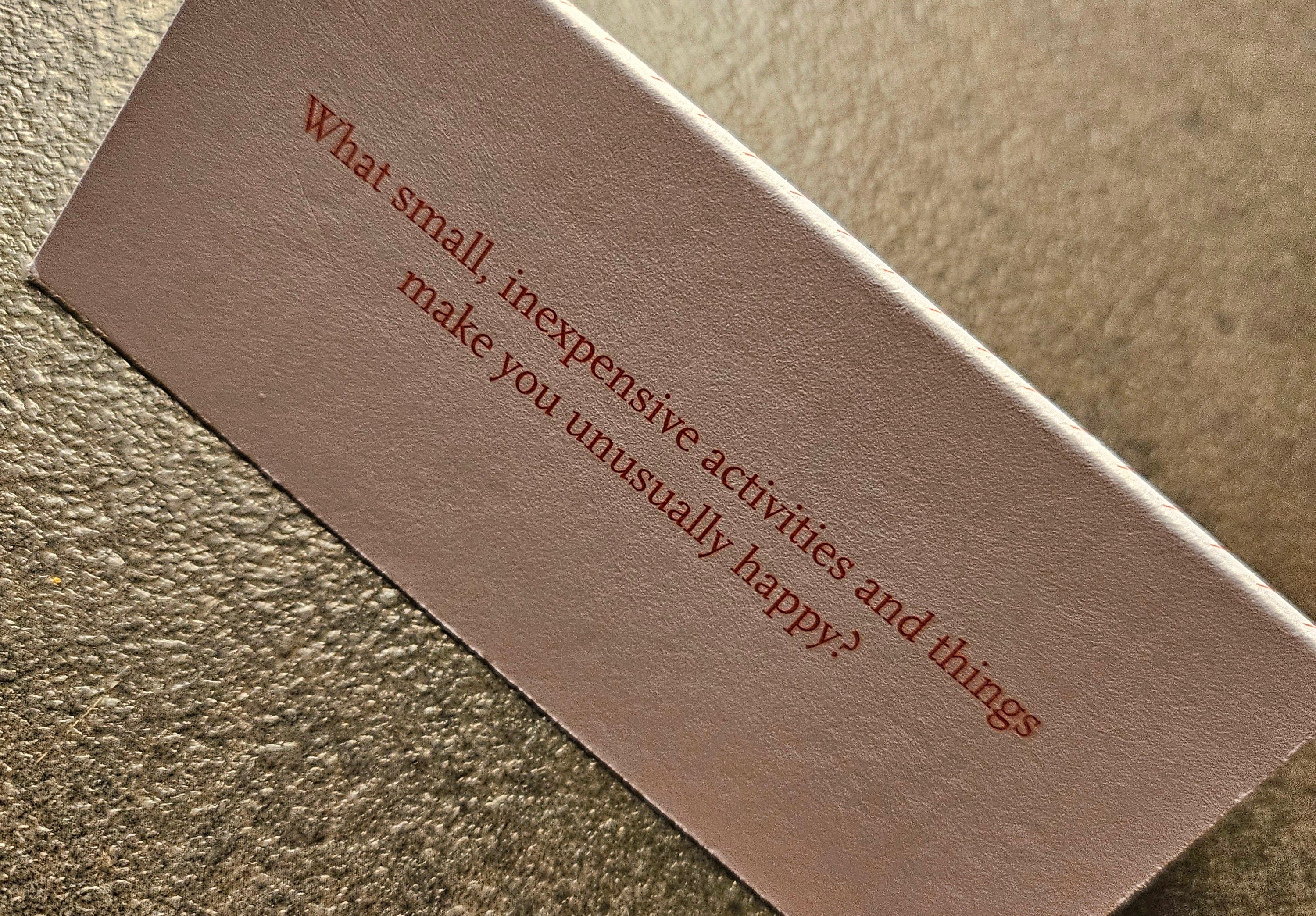
I have noticed that when I pick a question, a most random, somewhat bizarre, and seemingly unrelated (to the question), thought appears in my head. But if I follow it long enough, the answer reveals why it appeared in the first place. My initial thought when I read this question was a subtly dark but not melodramatic anecdote, I heard a long time ago from my father about a man who went to buy shoes and specifically asked for a smaller size. When the shop assistant asked why he wanted shoes that were too small, the man replied that, because he had very little joy in his life, he anticipated the happiness and relief he would feel when he took them off. I would not speculate on this man’s background, but I suspect most of us recognise the feeling he was anticipating. We have all experienced the loud relief of removing an uncomfortable pair of shoes. But, it is not the shoes themselves that matter here, but rather the absence of pain and discomfort. The relief feels good enough to be taken for a moment as happiness. 🙂


As someone who has suffered from chronic headaches from a young age, I know this feeling well, the relief can feel almost euphoric..often delivered by a single, modest paracetamol pill. Happiness, in this case is not a big event; it is just “disguised” as relief.
Happiness is a complicated business and definitely not something to be taken lightly. Biology tells us we are equipped with four so-called “feel-good” hormones: dopamine for small rewards, endorphins to dull pain, serotonin to keep our mood steady, and oxytocin to help us bond with the people we love.2 However, psychologists would likely argue that even if these feelings seem similar, relief, pleasure, happiness, and joy are not the same thing at all, they are actually very different states of mind. And just to complicate things further, philosophers have spent a lot of debating how different traditions define the pursuit of happiness. Perhaps Brenna Lee has already written about the subject. And, finally the wellness industry…has found a very profitable way to make money out of it.
At this point, there is a real risk that I could become entangled in the semantics, biology, physiology, and philosophy of relief, pleasure, happiness, and joy, without actually being a linguist, biologist, psychologist, or philosopher. For now, it seems enough to notice that happiness often emerges from unexpected corners, leaves a lot of room for interpretation and we are not always very good at spotting it. This idea brings to mind The Blue Bird by Maurice Maeterlinck (1908), which I saw years ago in a teather with my daughter. The play follows two children who travel far and wide in search of happiness, symbolised by the Blue Bird, only to discover, rather surprisingly, that it cannot be found in possessions, luxury, or grandeur. It cannot be captured even among joy, wisdom, or love, because it was never meant to be owned in the first place. A slightly disappointing, but comforting ending, the Blue Bird may have been at home all the time, just waiting for the search to end.
Besides, the question is formulated in a way that does not invite an elaborate answer about life goals, but rather to reflect on small, inexpensive experiences that make us feel happier than expected. But here is the thing, these so called activities and things change over time, they depend of the situation, or the state of mind we find ourselves in. For example now that the Christmas anticipation is over, the gifts have been opened (with equal parts excitement and disappointment), the decorations are back in their boxes, and the leftovers are gone, I found real joy in the New Year’s Concert from Vienna on the 1st of January. I thought the conductor Yannick Nezet-Seguin3 was formidable and I spend 2 delightful hours listening. I also made the traditional New Years Bulgarian pastry, baked with hidden lucky charms (Banitsa s kasmeti)4. I got “a new kitchen,” so now I am patiently waiting for the magical morning when I wake up and make my coffee in a brand-new kitchen, as if it has appeared overnight. We were lucky that it was snowing the whole day on 1st January, and we made a wonderful walk in the park under the falling snow…As a child, I spent many happy winter evenings at my grandparents’ house, with the wood-burning stove glowing and baked potatoes my grandfather used to make for us. As a young woman, happiness often sneaked in as a sense of belonging: being part of a group, having friends, being included and trusted with gossip, secretly smoking cigarettes to look cool, being noticed, flirting, you know what I mean. As a new mother, happiness felt like opening a present every morning when I woke up and saw my baby girl in her little bed. There are moments when you simply know you are happy, even if you don’t fully feel it at the time.
And then there are the “guilty pleasures”..a piece of chocolate, a glass of port, breakfast in bed….sometimes even an episode of “Ancient Aliens”5 would do… I know, don’t ask. There is no rational explanation; that’s why it is called a guilty pleasure. Still, I find myself wondering about two things:
a) If The Aliens from the Orion constellation gave us a push in ancient times and accelerated our evolution, who gave them the first push? After all, life has to originate somewhere.
b) And if those Aliens really cared about us, now would be a very good time for a visit, because we humans on Earth are clearly not doing great.
What I keep thinking about, though, are those days when everything feels effortless, days with a “golden edge,” when you believe you have finally cracked the secret of life and are ready to float toward the horizon, only to wake up the next morning and realize that “blue birds” are not a given, but a rare exception. That said, I have always been happy in nature: in the garden of the house I grew up in, and with a good book, reading and rereading my favorites.


But I live in Sweden, and I simply have to pay tribute to the country’s most beloved ritual: fika6. It’s one of the very first words you learn in Swedish, and for good reason. Fika can happen at any time of day and almost always involves freshly brewed coffee and something sweet. Similarly to the Afternoon Tea in the UK, Wiener Konditorei in Austria, or the Coffeeshops in the Netherlands (although the focus there is not, strictly speaking, on the coffee), fika is an institution.
While fika may seem like just a coffee and cake break, it holds a much deeper cultural significance in Sweden. It’s a moment to pause, connect and recharge – often more about the company and conversation than the coffee itself.
I love fika. One of my favourite things in the world is having fika with my daughter: chatting about books, films, life, gossip (just a little), occasionally solving worlds problems, or at least whatever tiny problem (if any) occurred that day. It is the perfect way to spend time together, with no pressure, and with cake.
What small, affordable things/activities will help you to get through the few dark, mundane months ahead and muddle through your New Year’s resolutions?
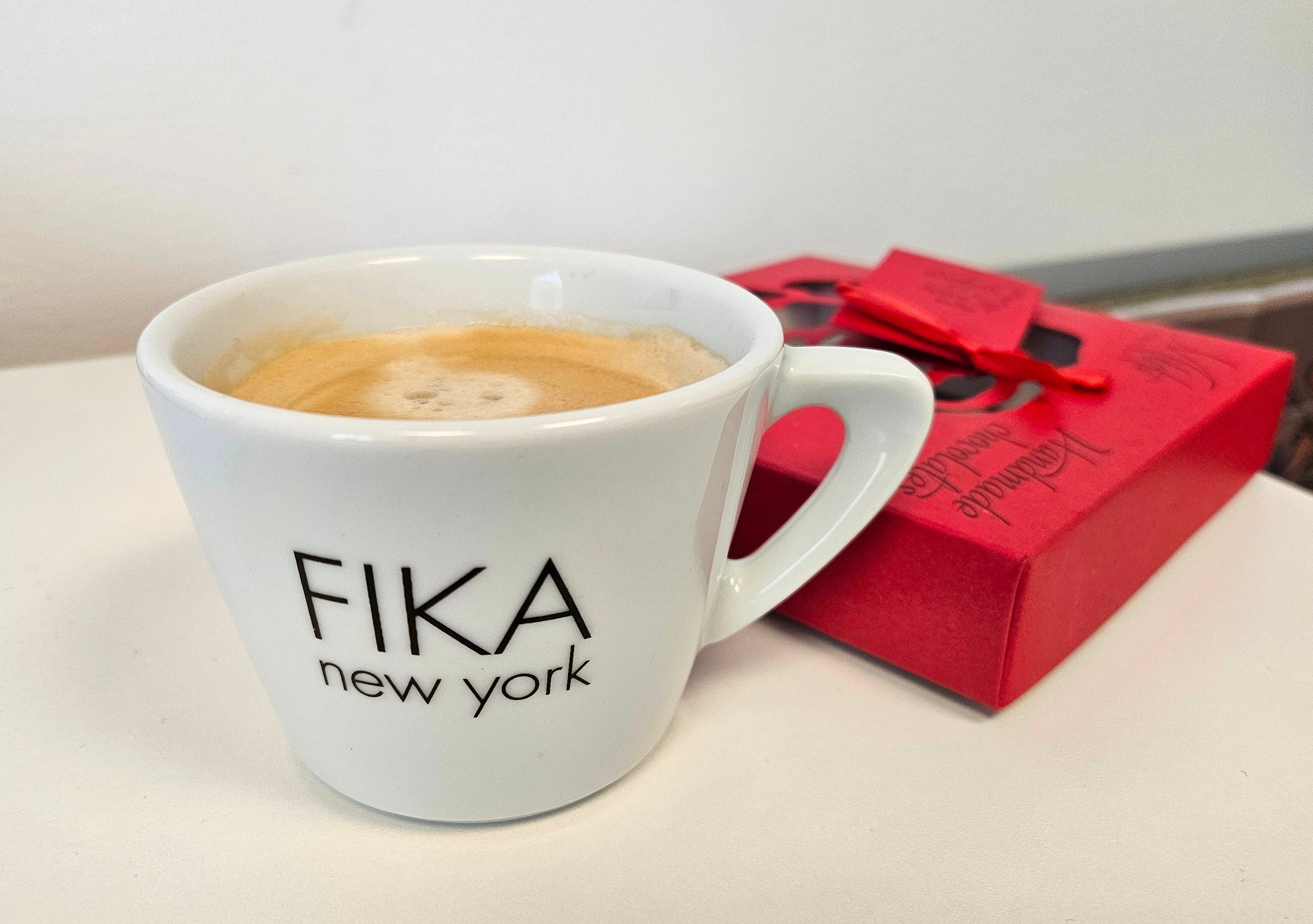
In 2012, we visited New York and, to our great surprise, stumbled upon a genuine Swedish FIKA café. By 2016, I read there were already 17 of them7. Sadly, they all closed in 2019. All I can say is this: I got myself a souvenir, but New York, you truly don’t know what you are missing.
Attributed to Bruce Springsteen
https://www.health.harvard.edu/mind-and-mood/feel-good-hormones-how-they-affect-your-mind-mood-and-body#:~:text=One%20group%20of%20hormones%20are,serotonin%2C%20endorphins%2C%20and%20oxytocin.
https://www.wienerphilharmoniker.at/en/newyearsconcert
https://sipofculture.com/2021/01/01/2021-fortunes-what-will-the-new-year-bring-you/#:~:text=On%20the%201st%20of,out%20which%20fortune%20it%20represents.
https://en.wikipedia.org/wiki/Ancient_Aliens
https://visitsweden.com/what-to-do/food-drink/swedish-kitchen/all-about-swedish-fika/
https://www.bbc.com/worklife/article/20160112-in-sweden-you-have-to-stop-work-to-chat
This is a four letter word worth living!
I love the depth of thought you are bringing to these questions, and it's such a beautiful beginning with your memory of your father's story. I too love the feeling of taking heels off after an extra long day. I first read this on the day you posted and first thought of reading as one answer, but perhaps it doesn't fit so much with the word 'unusual' at the end there. My thinking today is that a better answer might be hearing an old song I've not heard for ages play over the speakers in the supermarket while I am grocery shopping. I have no shame about singing along out loud (but quietly). That feeling of singing softly to a old song in public (which I would not do anywhere else) makes me happy. By comparison, I would say it's joyful to sing loudly with the speaker volume turned right up in the privacy of my own home when no one else is around to judge.